Social Media Marketing: The Complete Guide for 2026 (Strategy → Content → Scheduling)
Learn social media marketing with a practical, step-by-step system. Includes 5.04B-user context, proven frameworks, examples, and tools. 2026 guide.

Author
There are 5.04 billion social media users globally (or “user identities”) as of the start of 2024. That’s more people than live in any country, and the number is still growing.
https://datareportal.com/reports/digital-2024-deep-dive-5-billion-social-media-users
People also use several apps. The “typical” user spends 2 hours and 23 minutes per day on social media (GWI data cited by DataReportal).
https://datareportal.com/reports/digital-2024-deep-dive-the-time-we-spend-on-social-media
If you handle marketing for a small business, or you run several client accounts at an agency, that’s good news and bad news. Social works, but it can take over your whole week.
This guide covers: - A social media marketing strategy small enough to actually carry out - A content system (pillars, formats, and a weekly calendar) that keeps you posting - A simple weekly review that improves results without chasing vanity metrics - A 30-day action plan (with templates) to launch or fix your social
What is social media marketing?
Social media marketing is the process of using social platforms to reach the right audience, earn attention with content, build trust through consistency and interaction, and ultimately drive business outcomes (leads, sales, retention, referrals).
A useful definition from a business lens: it’s using social platforms to interact with customers to build brand awareness, increase traffic, and drive sales.
https://www.investopedia.com/terms/s/social-media-marketing-smm.asp
What social media marketing is not
- Posting every day and hoping
- Copying the same post to every platform
- Chasing every trend
- Chasing engagement that doesn’t connect to a business goal
Why social media marketing matters in 2026
1) Your audience is huge and uses several platforms
DataReportal reports the typical social media user visits/uses an average of 6.75 social platforms per month.
https://datareportal.com/social-media-users
Implication: if your strategy depends on one platform, one algorithm change can hurt you badly. You don’t need to be everywhere, but you do need a plan for how your platforms work together (discovery → trust → conversion).
2) People use social to research brands
DataReportal’s October 2024 “Global Statshot” reports that 46.1% of global internet users use social networks for brand research.
https://datareportal.com/reports/digital-2024-october-global-statshot
Implication: even if someone doesn’t buy on social, your social presence affects whether they trust you enough to click, subscribe, or purchase later.
3) Spend is massive (and competition is real)
WARC data has been reported as forecasting $247.3B in global social media ad spend in 2024 (+14.3% YoY).
https://mediabrief.com/social-media-ad-investment-247-3bn-in-2024/
Implication: if competitors are paying for reach, your organic posts have to be sharper and more consistent to compete.
4) Influencer marketing is now a standard lever
Influencer Marketing Hub projects the influencer marketing market reaching $32.55B by 2025 (and frequently references $24B for 2024).
https://influencermarketinghub.com/influencer-marketing-benchmark-report/
Implication: even if you never run an “influencer campaign,” creator-style content and partnerships are shaping what audiences trust.
5) In the US, the biggest platforms still dominate reach
Pew Research continues to report that YouTube and Facebook are the most widely used platforms among U.S. adults.
https://www.pewresearch.org/internet/fact-sheet/social-media/
https://www.pewresearch.org/internet/2024/01/31/americans-social-media-use/
Implication: “new” platforms matter, but your strategy should still respect where the audience actually is.
The social media marketing framework (the one you can run weekly)
Use this 5-part framework:
- Goal (what you want)
- Audience & positioning (who it’s for and why you)
- Content pillars & formats (what you post)
- Distribution & scheduling (how it ships consistently)
- Measurement & iteration (how it improves)
The steps below build all five.
How to create a social media marketing strategy (step-by-step)
Step 1: Set one primary goal (and pick the KPI that proves it)
Trying to improve every number at once usually means none of them improve.
Pick one primary goal for the next 30–90 days:
| Goal | Best-fit KPI (proof) | Supporting KPIs (signals) |
|---|---|---|
| Brand awareness | Reach / impressions | Follower growth, profile visits |
| Demand / leads | Leads (form fills, calls, demo requests) | Clicks, CTR, saves/shares |
| Sales (eCommerce) | Purchases, revenue | Add-to-cart, product page views |
| Community / retention | Repeat interactions, returning viewers | Comments, DMs, branded searches |
Rule: if you can’t measure it reasonably, don’t make it your primary goal (yet). Start with what you can track consistently.
Step 2: Define your audience in “scroll language,” not persona PowerPoints
A usable social audience definition includes:
- Who: role + stage (e.g., “new homeowners” vs “DIYers”)
- Problem: what they’re trying to fix/achieve
- Trigger: what makes them stop scrolling
- Promise: what they get from following you
Example (local gym):
- Who: busy professionals (25–45) near the gym
- Problem: wants to get fit without thinking about workouts
- Trigger: “30-minute plan,” “done-for-you,” “real people results”
- Promise: simple workouts + accountability + community
Example (B2B agency):
- Who: founders/marketing managers at SMBs
- Problem: needs consistent leads without hiring a full internal team
- Trigger: proof, clear offers, “what we’d do in 30 days”
- Promise: practical playbooks + case-study patterns
Step 3: Craft a simple positioning statement (your “why you”)
Use this template:
We help [audience] achieve [result] using [unique method] without [common pain].
Examples:
- “We help local service businesses generate predictable leads using short-form video + local SEO, without spending hours editing.”
- “We help B2B founders turn expertise into demand using LinkedIn content systems, without posting daily.”
Use it for your profile bio and your content themes, and to decide what you won’t post about.
Step 4: Choose platforms based on behavior (not hype)
A practical platform selection matrix:
| Platform | Best for | Content that tends to work |
|---|---|---|
| Consumer brands, creators, local businesses | Reels, carousels, before/after, UGC | |
| TikTok | Broad awareness + discovery | Short video, series, trends (filtered) |
| B2B trust + pipeline | POV posts, carousels, founder stories, case studies | |
| YouTube | Evergreen discovery + authority | Tutorials, explainers, Shorts + long form |
| Local + community + older demos | Community posts, events, offers, video | |
| X (Twitter) | Fast feedback + ideas + B2B tech | Opinions, threads (native), quick insights |
| Threads | Casual brand voice + conversation | Short text, memes, light education |
| Bluesky | Early adopter communities | Text-first, niche conversations |
If you use a scheduler, note that not every scheduler supports every post type on every platform (e.g., Stories, threads, documents). Plan workflows accordingly.
Step 5: Build content pillars (so you never start from scratch)
Create 3–5 pillars. These are repeatable buckets that map to audience needs and your offer.
Pillar template: - Pillar name - Who it’s for - Problem it solves - 5–10 repeatable post ideas - Best format(s) per platform
Example pillar set (service business)
- Proof & results (case studies, before/after, testimonials)
- Education (how-to, mistakes, quick tips)
- Process & behind-the-scenes (how you work, what clients can expect)
- Offers & promotions (limited but clear)
- Community & values (people, culture, local ties)
Example pillar set (B2B)
- Category education (teach the problem)
- POV / contrarian takes (different thinking)
- Frameworks (step-by-step processes)
- Proof (case studies, numbers, lessons learned)
- Product/service moments (demos, FAQs, objections)
Step 6: Decide your “core formats” (the 80/20 of production)
Pick 2–3 “core formats” you can produce weekly without burnout.
Common core formats:
- Short video series (e.g., “1 tip/day for 14 days”)
- Carousel frameworks (e.g., “5 mistakes,” “checklist,” “template”)
- Founder POV posts (especially LinkedIn / X)
- UGC/testimonial clips (consumer brands)
- Live Q&A recap posts (turn one live session into many posts)
For most businesses, posting consistently does more than chasing a viral hit.
Step 7: Build a social media content calendar (weekly, not monthly fantasy)
You can plan themes by month, but plan the actual posts week by week.
Here’s a simple weekly calendar you can copy:
| Day | Content type | Pillar | CTA |
|---|---|---|---|
| Mon | Educational “myth vs reality” | Education | Save / follow |
| Tue | Proof (case study snippet) | Proof | Click / inquire |
| Wed | Behind-the-scenes | Process | Comment / DM |
| Thu | Framework checklist | Frameworks | Save / share |
| Fri | Soft promo / offer | Offer | Book / buy |
| Sat | Community / culture | Community | Engage |
| Sun | Repurpose best post | Any | Follow |
If you’re an agency managing multiple clients: standardize this template, then swap pillar examples per industry. That way you can add clients without spending all day in publishing tabs.
Step 8: Create a distribution plan (how content travels)
Many brands post something once and move on. Try this instead:
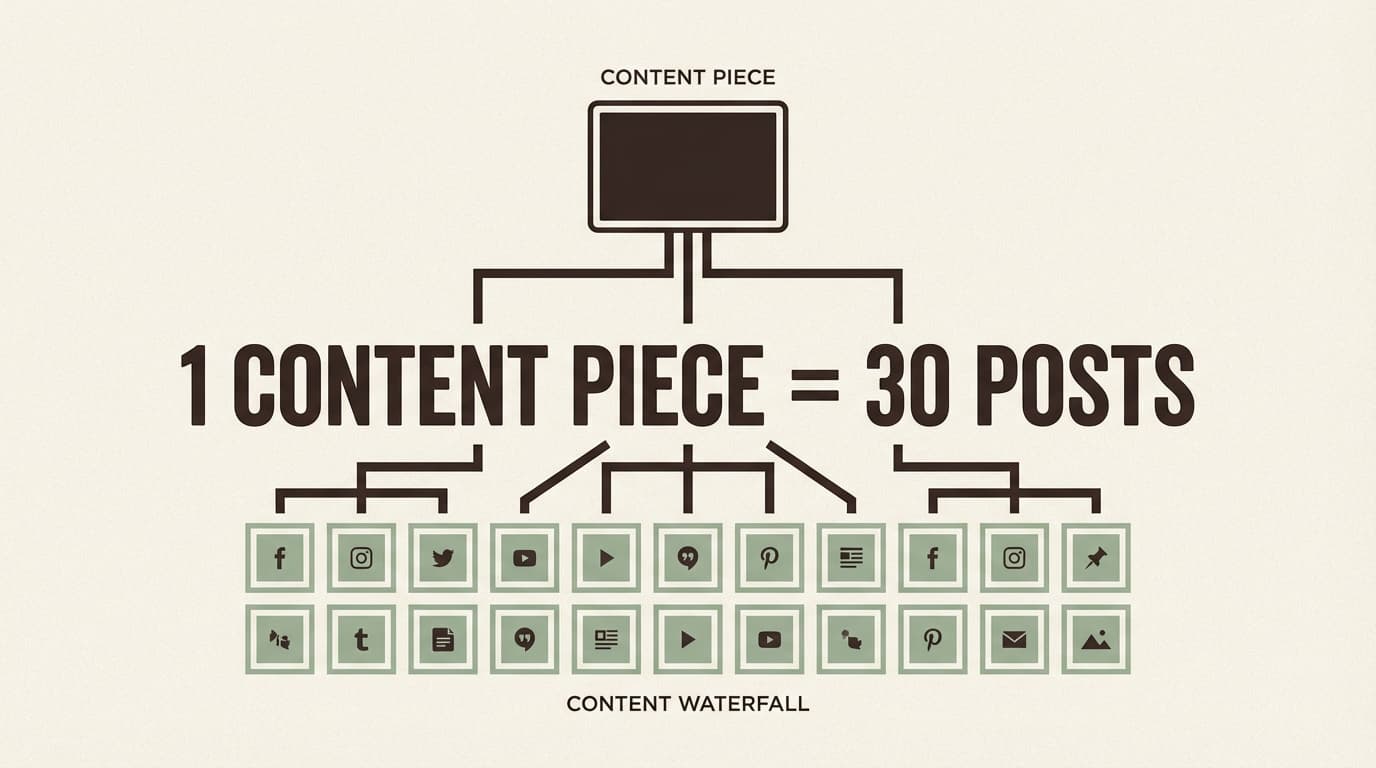
The “1–3–5 distribution loop”:
- 1 core idea per week
- 3 assets from it (video, carousel, text post)
- 5 re-posts/re-angles (clips, quotes, FAQs, objections, examples)
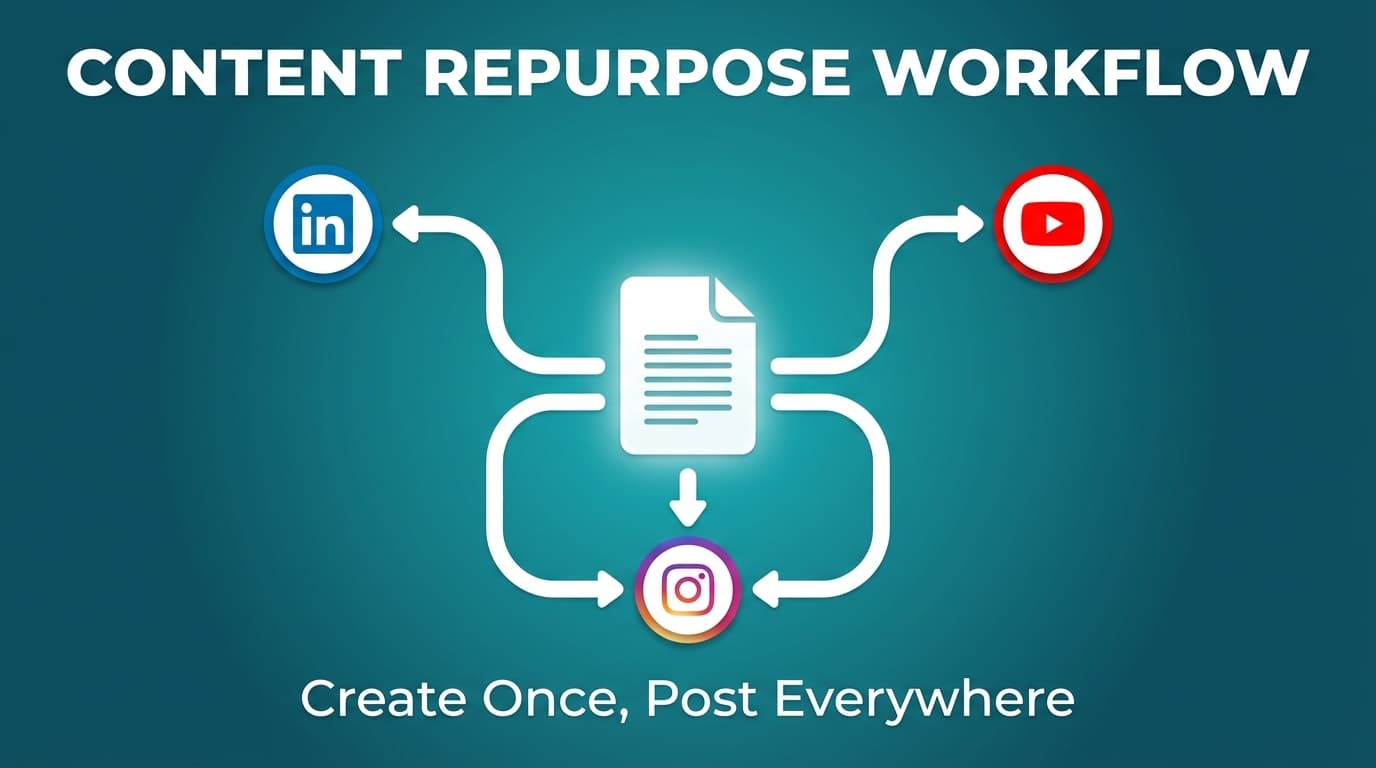
Example: one client win →
- LinkedIn: case study post + carousel breakdown
- Instagram: before/after + Reel recap
- X: 5 quick lessons
- TikTok: “what we changed” series
Step 9: Schedule it (so it actually happens)
If your social plan depends on “posting manually when you have time,” you’ll lose consistency the first week you get busy.
Create in batches, schedule in batches, and reply to people daily.
If you use PostQuickAI, you can schedule and auto-publish supported post types across multiple networks (platform support varies by post type):
- Instagram: single-image feed posts, carousels, Reels, and Stories (image, or video up to 60 seconds)
- Facebook Pages: text, photos, carousels, video, and Stories (Pages only; personal profiles aren’t supported)
- LinkedIn: text, images, multi-image, and video (you must select personal vs organization target; documents/polls/newsletters/articles aren’t supported)
- TikTok: video and photo carousels (photo posts require at least 2 images)
- X (Twitter): text, up to 4 images, video, and native threads (each part publishes as a linked reply)
- Bluesky: text, images (up to 4), and video
Pricing note: PostQuickAI plans start at $15/month and your first plan starts with a 7-day free trial (card required).
/pricing
Step 10: Measure weekly, iterate monthly
You don’t need a complex dashboard to improve.
Run this weekly meeting (30 minutes):
- Top 3 posts by reach (what got attention?)
- Top 3 posts by saves/shares/comments (what built trust?)
- Top 3 posts by clicks/leads/sales (what moved business?)
- What to repeat next week (format + hook + topic)
- What to stop doing (low effort, low signal)
Then run one monthly retro:
- Keep / change pillars
- Add/remove a format
- Adjust how often you post, with quality and fit in mind as well as volume
Social media marketing best practices that move results
These come up in most of the big guides (Buffer, Sprout Social, HubSpot, Forbes), and they hold up when you actually do them.
1) Prioritize consistency over novelty
Teams usually stall because they can’t keep up the pace they started with. Pick a posting schedule you can keep for 12 weeks.
Practical rule: choose a posting volume that still lets you respond to comments and DMs.
2) Create platform-native versions (don’t cross-post blindly)
Same idea, different packaging:
- LinkedIn: context + POV + takeaway
- Instagram: visual hook + carousel structure
- TikTok: hook in 1 second + fast pacing
- X: punchy insight + conversation starter
3) Use “hooks” that match intent
Hooks that consistently work:
- “If you’re doing X, stop.” (mistake hook)
- “Here’s the exact template we use.” (framework hook)
- “I used to believe X. I was wrong.” (belief shift hook)
- “Before/after: what changed.” (proof hook)
4) Make sharing easy (build for saves and forwards)
Add:
- checklists
- “copy/paste” scripts
- swipe files
- step-by-step “do this next” instructions
5) Build a repeatable engagement habit
Engagement needs a daily habit, not the occasional reply.
15-minute daily loop:
- reply to all comments on recent posts
- respond to DMs/questions
- leave 5 thoughtful comments on niche-relevant accounts
- save 3 content ideas
6) Create a “content library” (reuse what works)
Don’t reinvent:
- top posts → remake as new format
- FAQs → become weekly content
- objections → become myth-busting series
- case studies → become proof assets
7) Separate “organic social” and “paid social” roles
Organic = trust + positioning + creative testing.
Paid = distribution + conversion testing.
Use organic posts to find the messages people respond to, then put ad money behind those.
8) Test one variable at a time
Examples of clean tests:
- same topic, different hook
- same hook, different format
- same format, different CTA
Social media marketing examples (by goal)
Famous brand campaigns rarely translate to a small account, so these are examples you can copy.
Example 1: Brand awareness (local service business)
Format: Instagram Reel + carousel follow-up
Hook: “3 signs your [problem] is getting worse”
CTA: “Follow for weekly fixes”
Why it works: high relevance + repeatable series
Example 2: Lead generation (B2B agency)
Format: LinkedIn carousel
Title slide: “If your leads slowed down, fix these 5 things first”
Slides:
1. Positioning
2. Offer clarity
3. Landing page friction
4. Proof placement
5. Follow-up speed
CTA: “Comment ‘AUDIT’ and I’ll send the checklist”
Note: Only offer this if you’ll actually send the checklist yourself. Don’t automate the replies.
Example 3: Product sales (eCommerce)
Format: TikTok video
Hook: “I bought 3 versions so you don’t have to”
Structure: quick comparison → winner → why
CTA: “Link in bio” / product tag
Why it works: reduces buying risk
Example 4: Community building (creator / educator)
Format: Threads post or X post
Hook: “Unpopular opinion: [category take]”
End: “What’s your experience?”
Why it works: people reply with their own view instead of just liking it
Common social media marketing mistakes (and how to fix them)
Mistake 1: Posting without a strategy
Symptom: random posts, inconsistent messaging, no compounding growth.
Fix: create pillars + weekly calendar + one primary goal.
Mistake 2: Using every platform at once
Symptom: burnout, low quality, no feedback loop.
Fix: pick 1–2 primary platforms + 1 secondary. Expand after 8–12 weeks of consistency.
Mistake 3: Copy/pasting across platforms
Symptom: content feels “off,” low engagement, weak retention.
Fix: same idea, platform-native rewrite.
Mistake 4: Only selling (or never selling)
Symptom: your audience tunes out, or you build an audience that never buys.
Fix: use a balanced mix: education + proof + occasional offer.
Mistake 5: Measuring only vanity metrics
Symptom: you “grow” but don’t get leads/sales.
Fix: tie content to business outcomes (even if it’s directional).
Mistake 6: No content reuse
Symptom: constant idea pressure.
Fix: reuse winning posts in new formats monthly.
Tools to help with social media marketing (honest picks)
You don’t need a huge stack. Most teams need:
1) creation help
2) a content calendar
3) scheduling
4) basic tracking
Scheduling + creation workflow
- PostQuickAI: Helps you create and schedule posts and auto-publish supported formats across platforms (Instagram feed posts/carousels/Reels; Facebook Pages posts; LinkedIn posts; X posts; TikTok videos + photo carousels; Bluesky posts). Includes AI caption generation and AI image generation, plus utilities like a caption generator and hashtag generator.
- Pricing: plans start at $15/mo with a 7-day free trial on your first plan (card required).
- Notes: Instagram and Facebook Stories are now supported; LinkedIn documents/polls/newsletters/articles aren’t supported; TikTok photo posts require 2+ images.
- /instagram-scheduler, /linkedin-scheduler, /x-scheduler, /tiktok-scheduler, /bluesky-scheduler, /pricing
Free visual planning (Instagram-focused)
- PostQuickAI Instagram Feed Planner: a free Instagram grid/feed planner tool (no login required) to preview your grid before posting.
/tools/instagram-feed-planner
Education + benchmarking
- Sprout Social guides (best times to post; strategy frameworks), good for benchmarks and structure.
https://sproutsocial.com/insights/social-media-marketing-strategy/ - Buffer guides (strategy and platform-specific studies), good for readable how-tos and research summaries.
https://buffer.com/social-media-marketing
https://buffer.com/resources/when-is-the-best-time-to-post-on-instagram/
(Note: these recommendations are based on public information and common usage. Features change, so check each vendor’s site.)
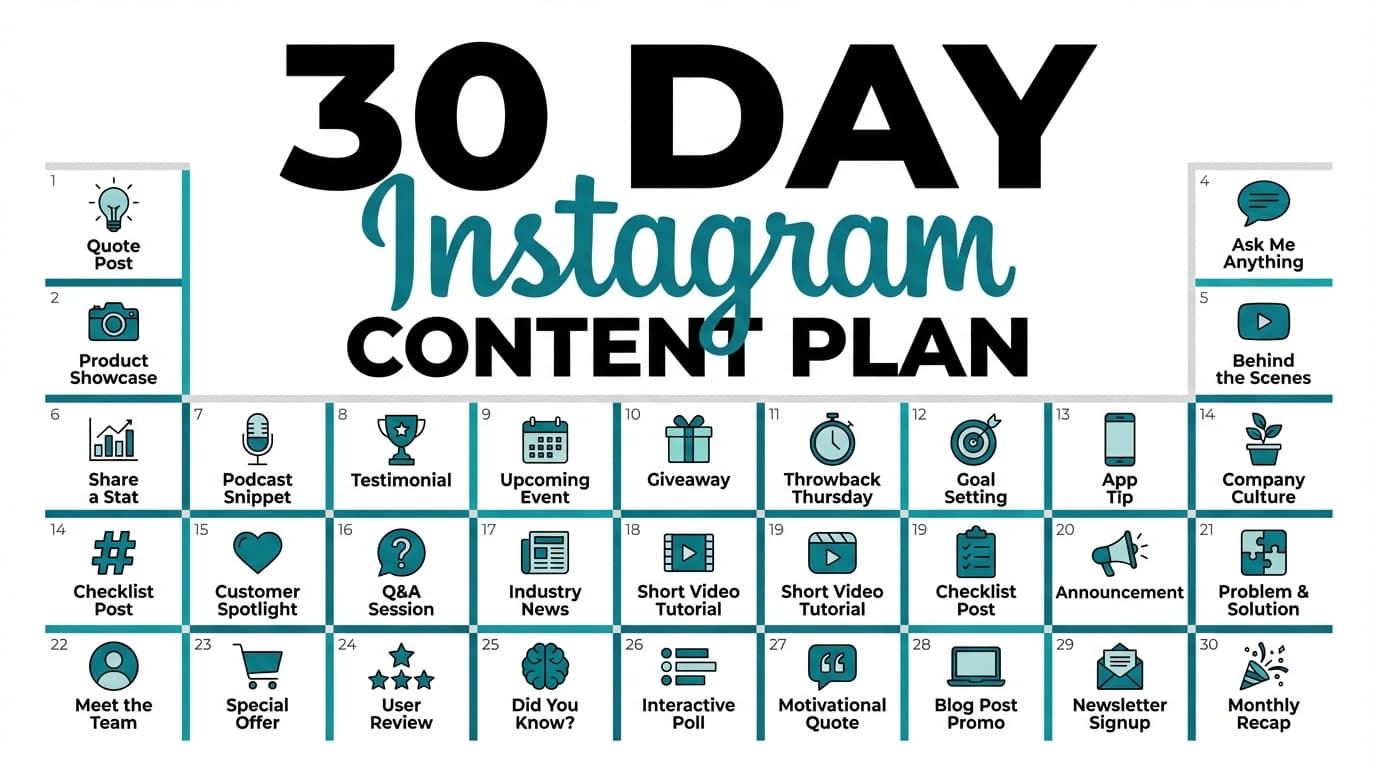
The 30-day social media marketing action plan (copy/paste)
Week 1: Foundation
- Choose primary goal + KPI
- Pick 1–2 platforms
- Write positioning statement
- Define 3–5 pillars
- Draft 10 post ideas per pillar (50 ideas total)
Week 2: Production system
- Choose 2–3 core formats
- Create your first batch:
- 2 carousels
- 2 short videos
- 2 proof posts
- 1 community post
- Write a reusable caption template + CTA bank
Week 3: Schedule + engagement loop
- Schedule 7–10 posts (1–2 weeks ahead)
- Commit to daily 15-minute engagement loop
- Track outcomes weekly
Week 4: Optimize
- Identify your top posts by reach, saves/shares, and clicks/leads
- Turn the #1 post into 3 new variations
- Remove one low-performing format
- Plan next month based on what worked
Key takeaways
- Social media marketing works best as a system: strategy → content → scheduling → iteration.
- Your advantage comes from posting consistently and reusing what works.
- Use a weekly content calendar and a repeatable distribution loop so marketing doesn’t collapse when you get busy.
- Tools can help you ship consistently, but always confirm platform support and post-type limitations.
FAQ (from common searches & “People Also Ask”)
What is social media marketing in simple words?
Social media marketing is using platforms like Instagram, TikTok, LinkedIn, and YouTube to reach people with content, build trust, and drive business results (like leads or sales).
What is the 50/30/20 rule for social media?
There are multiple versions of the “50/30/20 rule.” A common interpretation is:
- 50% value/engagement content
- 30% brand-building or curated content
- 20% promotional content
Tip: treat this as a starting point, then adjust based on what your audience responds to.
What are the 7 C’s of social media marketing?
The “7 C’s” framework varies by author. One commonly cited version includes: Community, Content, Curation, Creation, Connection, Conversation, Conversion.
Use it as a checklist: are you talking with your community, or only broadcasting at it?
How do I start social media marketing from scratch?
Start with:
1) one goal
2) one audience
3) 3–5 pillars
4) 2 core formats
5) a weekly posting schedule
Then improve weekly using your top-performing posts.
How often should I post on social media?
There’s no universal number. A practical starting point:
- 3–5 posts/week on your primary platform
- 1–3 posts/week on a secondary platform
Increase only when you can maintain quality and engagement follow-through.
What’s the best time to post on social media?
Benchmark studies can help (Sprout Social, Hootsuite, Buffer publish time recommendations), but the best time is ultimately when your audience is most likely to engage.
Use a simple test: post the same content type at two different time windows for two weeks and compare results.
What tools do I need for social media marketing?
At minimum:
- A planning system (content calendar)
- A way to create content (design/video tools)
- A scheduling tool (to stay consistent)
Optional: link tracking + basic reporting.
Can PostQuickAI schedule Instagram Stories?
Yes. PostQuickAI schedules Instagram and Facebook Stories: add an image or video Story and it publishes automatically. See the social media scheduler overview for everything it covers.
Can PostQuickAI schedule TikTok photo posts?
Yes, but TikTok photo posts require at least 2 images (single-image photo posts aren’t supported).