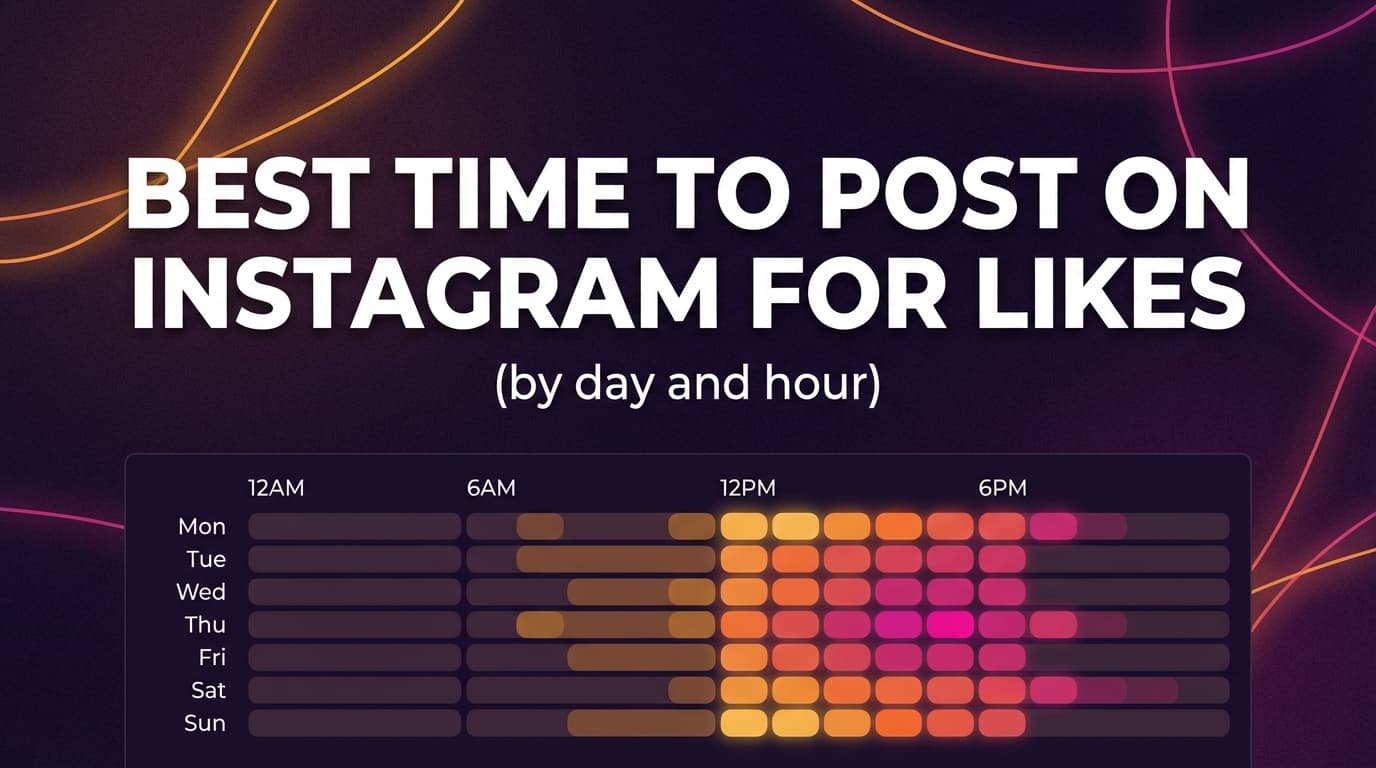
Best Time to Post on Instagram for Likes (By Day & Hour): Complete Guide for 2026
Learn the best time to post on Instagram for likes by day and hour, plus how to find your personal best times using Instagram Insights. 2026 guide.
Author
Posting at the wrong time can make great content look average, especially if the post misses the hours when your followers are scrolling and liking.
Most “best time to post” articles give you a single magic hour. In reality, the best time to post on Instagram for likes depends on:
- Your audience’s location and routine
- Your content format (Reels vs carousels vs photos)
- How fast your post earns engagement signals (likes, comments, shares, saves)
- Consistency (so you build predictable patterns and collect clean data)
This guide gives you:
1) a by-day and by-hour baseline schedule you can use immediately, and
2) a short, repeatable test to find your best times, which is what matters in the long run.
This guide covers: - The best time to post on Instagram for likes by day and hour (practical “start here” table) - What major studies agree on, and why they still conflict - How Instagram’s ranking signals make good timing help good posts (with official sources) - How to find your best times using Instagram Insights - A 14-day timing test (with a tracking template) - Common timing mistakes that cost you likes - Tools to schedule posts and hit peak windows consistently
What “best time to post” means (specifically for likes)
When you’re optimizing for likes, you’re optimizing for two things:
1) Initial visibility: more of your followers are online to see the post soon after publishing
2) Early engagement: a higher percentage of those viewers like it quickly (and that can help distribution)
Instagram has explained that it uses many signals to rank content, including signals about how popular a post is, such as how many people have liked it and how quickly people are liking, commenting, sharing, and saving.
Source: https://about.instagram.com/blog/announcements/instagram-ranking-explained
Timing can’t force likes, but it gives a good post the best chance to earn them early.
Why posting time still matters in 2026 (even with a ranked feed)
A ranked feed doesn’t make timing irrelevant; it changes how timing helps.
1) Early engagement is a ranking signal
Instagram’s official “Ranking Explained” article explicitly calls out popularity signals (including how quickly engagement happens).
Source: https://about.instagram.com/blog/announcements/instagram-ranking-explained
Meta’s Transparency Center also describes ranking systems that use signals and predictions to select content people are likely to engage with.
Source: https://transparency.meta.com/features/explaining-ranking/
2) Your followers still have daily attention cycles
Even with personalization, people tend to open Instagram at predictable moments: - Morning routine - Lunch breaks - After work/school - Evening “scroll time”
That’s why most reputable datasets still cluster around similar time windows (morning, midday, late afternoon, evening), even if they disagree on the single best hour.
3) Instagram’s scale makes small gains worth it
Instagram is big enough that small improvements add up over a few weeks.
-
DataReportal reports Instagram ads reached 21.3% of all people on Earth in January 2025 (ad reach data).
Source: https://datareportal.com/essential-instagram-stats -
DataReportal (citing GWI) reports the “typical” social media user spends 2 hours and 23 minutes per day using social platforms.
Source: https://datareportal.com/reports/digital-2024-deep-dive-the-time-we-spend-on-social-media
What the biggest studies say (and why you see different “best times” everywhere)
Several well-known social media platforms/tools publish large-scale analyses:
-
Buffer analyzed 2+ million Instagram posts sent through Buffer.
Source: https://buffer.com/resources/when-is-the-best-time-to-post-on-instagram/ -
Hootsuite analyzed 1+ million social posts (across networks) and publishes Instagram-specific “best times.”
Source: https://blog.hootsuite.com/best-time-to-post-on-instagram/ -
SocialPilot reports a study using 50K accounts and 7 million posts.
Source: https://www.socialpilot.co/blog/best-time-to-post-on-instagram -
Later reports analyzing 6M+ Instagram feed posts for overall best time recommendations (and also publishes Reels-specific analyses).
Source: https://later.com/blog/best-time-to-post-on-instagram/ -
Sprout Social publishes updated “best times” guidance based on its dataset.
Source: https://sproutsocial.com/insights/best-times-to-post-on-instagram/
Why these sources disagree (and why that’s normal)
Different studies can be “right” at the same time because they differ in: - Time zones (local vs global vs converted) - Audience type (brands vs creators vs agencies) - Content mix (Reels-heavy vs feed-heavy) - Success metric (reach vs engagement vs clicks) - Industry mix (B2B vs B2C) - Seasonality (different months/years)
Treat these studies as a baseline, then adjust with your own Insights and a short test.
Best time to post on Instagram for likes (by day and hour): the practical baseline schedule
Below is a by-day and by-hour schedule meant to get you more likes without leaning too hard on any one study.
Use it as your default calendar for 2 weeks, then refine it with your Insights.
Quick rule for the whole week (if you only remember one thing)
Aim for these three windows (local time):
- Morning: 7–9 AM
- Midday: 11 AM–1 PM
- Evening: 6–9 PM
These windows come up in many guides, but test them before assuming they’re the best for your account.
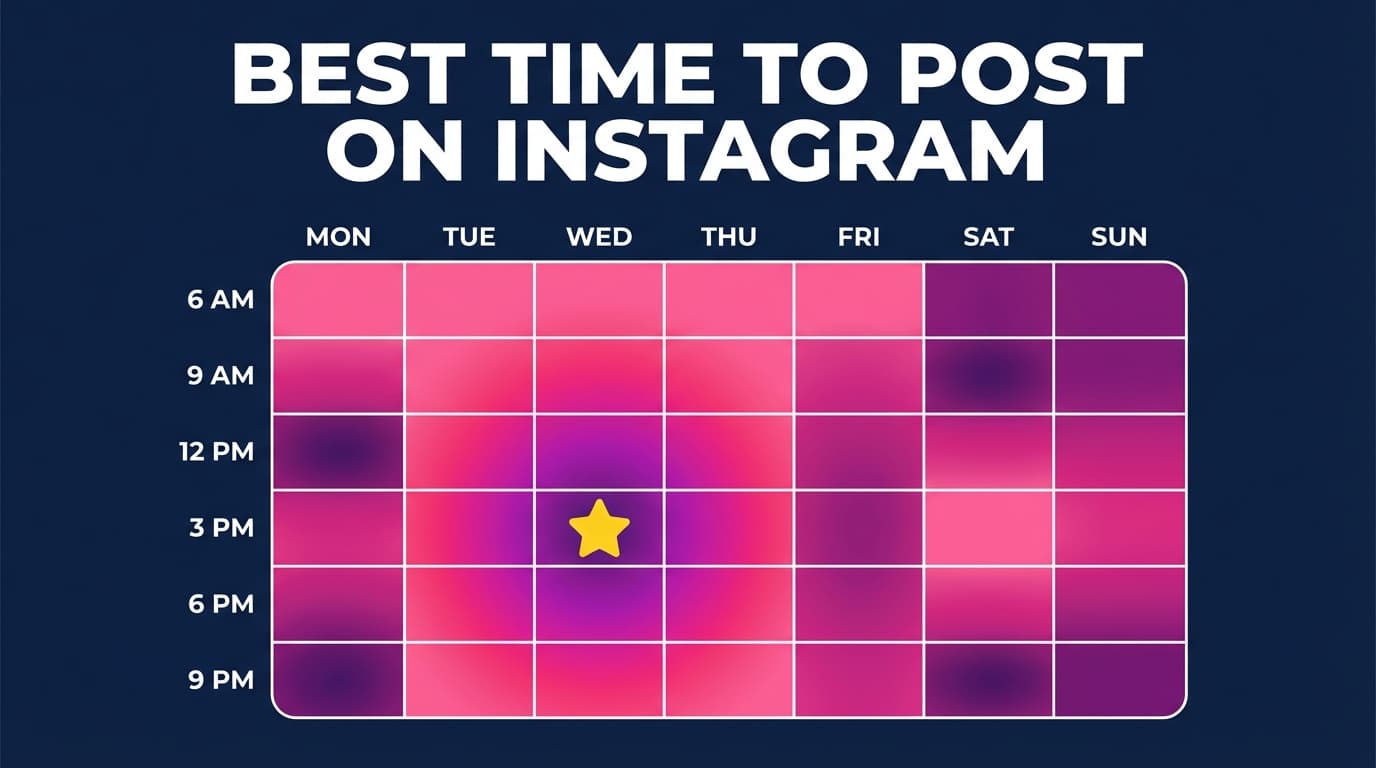
The full by-day and by-hour table (Local Time)
| Day | Best times to post for likes (start here) | Why these hours tend to work |
|---|---|---|
| Monday | 7–9 AM, 11 AM–1 PM, 6–8 PM | Morning reset + lunch break + after-work scroll |
| Tuesday | 7–9 AM, 11 AM–2 PM, 5–7 PM | Strong weekday attention; predictable breaks |
| Wednesday | 7–9 AM, 11 AM–2 PM, 6–8 PM | Midweek consistency; good “routine” day |
| Thursday | 7–9 AM, 11 AM–2 PM, 6–9 PM | Often a high-performing weekday; evening browsing rises |
| Friday | 7–9 AM, 11 AM–1 PM, 3–5 PM | Earlier wins; later attention can fragment |
| Saturday | 9–11 AM, 12–2 PM, 6–9 PM | Later morning start; strong evening leisure scroll |
| Sunday | 9–11 AM, 4–6 PM, 7–9 PM | Slow morning + “prep for week” evening scroll |
How to use this table (fast): - If you post 3x/week: pick Tue/Thu/Sat and choose one window each. - If you post 5x/week: use the best weekday windows + one weekend slot. - If you post daily: rotate windows to avoid always competing at the same time.
Treat the exact hours as a starting point. The underlying idea, that daily routines create predictable busy periods, is well established.
The “best hour” shortcut (when you need one time and can’t overthink it)
If you need one consistent hour for the next two weeks:
- Try 12:00 PM (noon) local time, Tuesday–Thursday.
Why noon? It comes up as a strong slot in many “best time” guides (people scroll on lunch breaks), and it’s easy to stick to.
Post at peak time, or before it?
If your followers are most active at 7 PM, should you post at 7 PM?
A practical approach: - Post 30–60 minutes before your peak follower activity hour so your post is already in-feed as the activity surge starts.
This aligns with the idea that early engagement velocity matters (and gives you time to reply to comments quickly).
Best posting times by content type (likes behave differently by format)
Timing works best when it matches how people consume the format.
Feed photos (single image)
Best starter windows: 11 AM–1 PM, 6–8 PM
Why: quick scroll decisions + higher browsing time midday/evening
Carousels
Best starter windows: 11 AM–2 PM, 6–9 PM
Why: people are more likely to swipe and spend time when they’re not rushed
Reels
Best starter windows: 12–2 PM, 6–9 PM
Why: users watch longer when they have “scroll time”; evening often increases session length
Note: Some datasets report very early hours for Reels performance; treat that as something to test, not a universal rule, especially if your audience isn’t online overnight. Later publishes Reels-specific analyses (see: https://later.com/blog/best-time-to-post-on-instagram/).
If you’re posting for a business account (B2B vs B2C timing)
A common pattern across guides: - B2B tends to perform better during working hours and lunch (11 AM–1 PM) - B2C often performs well during evenings (6–9 PM)
This is heavily audience-dependent, but it’s a useful hypothesis to test quickly.
Time zones: the most common reason “best time to post” advice fails
Two creators can post at “6 PM” and get completely different results because “6 PM” means different things in different places.
Step 1: Identify where your followers actually are
Use Instagram Insights to view audience locations and activity.
Instagram Help Center explains how to access insights via the Professional dashboard.
Source: https://help.instagram.com/1533933820244654
Step 2: Choose one “primary” time zone
Pick the time zone where your largest follower cluster lives.
Step 3 (optional): Add a second window if your audience is split
If your audience is split (e.g., US + UK), use: - one midday slot for Region A, and - one evening slot for Region B
How to find your best time to post on Instagram for likes (using Insights)
A universal chart is only a starting point. What you want are your account’s best windows.
Step 1: Make sure you have access to Insights
You generally need a professional account to access the Professional dashboard and insights views.
Source: https://help.instagram.com/1533933820244654
Step 2: Record your follower “Most active times”
Write down: - Top 3 active days - Top 3 active hours on those days
Step 3: Compare those times to your actual post performance
Look at your last 20–30 posts and note: - Posting day/time - Format - Topic - Likes at 24 hours (and optionally at 1 hour)
You’re looking for patterns such as: - “My audience is active at 9 PM, but my likes peak at 6 PM.” - “Carousels win at lunch; Reels win at night.”
Step 4: Choose two “candidate windows”
Pick: - Window A (your best guess) - Window B (your alternative)
Now test them.
The 14-day testing plan
Most timing tests fail because people change everything at once. This plan changes only the time.
What you’ll test
- Two time windows, e.g.:
- Window A: 11 AM–1 PM
- Window B: 6 PM–8 PM
Rules (so the test is valid)
For 14 days:
1. Keep the format consistent (e.g., only carousels, or only Reels).
2. Alternate windows:
- Mon: A
- Tue: B
- Wed: A
- Thu: B
- …repeat
3. Keep the creative “level” consistent:
- similar effort, similar topic depth, similar CTA style
4. Measure at the same checkpoints:
- Likes @ 1 hour (optional)
- Likes @ 24 hours (recommended)
- Likes @ 48 hours (optional)
Why this works (in plain English)
You’re only finding out which of your two best guesses works better for your account.
Copy/paste tracking template
| Date | Day | Time | Window (A/B) | Format | Topic | Likes @1h | Likes @24h | Notes |
|---|---|---|---|---|---|---|---|---|
| 2026-02-01 | Sun | 10:30 AM | A | Carousel | Tips | 40 | 280 | Strong saves |
| 2026-02-02 | Mon | 6:30 PM | B | Carousel | BTS | 55 | 340 | More comments |
Decision rule: After 14 days, whichever window has higher average Likes @24h becomes your default.
Common mistakes that cut likes (even when you “post at the best time”)
Mistake 1: Posting inconsistently (so you never collect clean data)
If you post three times one week and disappear the next, your “best time” conclusions will be noisy.
Fix: choose a sustainable cadence first (3–5 posts/week), then optimize timing.
Mistake 2: Measuring only total likes, not early likes
If early engagement speed matters, you should track at least one early checkpoint (like 1 hour) plus 24 hours.
Instagram has described popularity signals including how quickly engagement happens.
Source: https://about.instagram.com/blog/announcements/instagram-ranking-explained
Mistake 3: Testing times while switching formats
Reels and carousels can have different engagement curves.
Fix: test timing within one format first.
Mistake 4: Posting exactly at the most competitive moment
Peak hours can be crowded. Often, 30–60 minutes before peak activity is a better place to start.
Fix: test “before peak” vs “at peak” for 2 weeks.
Mistake 5: Ignoring time zones
If your followers are in multiple regions, “6 PM” means nothing unless you define whose 6 PM.
Fix: pick a primary follower time zone (Insights), then schedule accordingly.
Best practices to get more likes when you post
Good timing only helps a post that people want to like:
-
Hook immediately - Reels: hook in the first second - Carousels: strong slide 1 headline - Photos: high-contrast focal point + first caption line that earns a pause
-
Use a “likeable” CTA - “Which one are you: A or B?” - “Save this for later” - “Send this to a friend who needs it”
-
Be online for 10–20 minutes after posting (if possible) Replying quickly can jumpstart the comment section.
-
Repeat winning windows Once you find a winner, use it consistently for a month before changing again.
Tools to help you hit peak times consistently
If you manage several accounts or you’re busy during peak hours, knowing the best time is the easy part. Posting at that time every week is harder.
PostQuickAI (schedule Instagram feed posts, Reels and Stories)
If you want to lock in your best posting windows without manual reminders, PostQuickAI can help you schedule and auto-publish:
- Instagram feed posts (single-image, video, and carousel)
- Instagram Reels
It also includes an assistant in the composer for captions (drafting, proofreading, tone changes), which helps you batch-create posts faster and then schedule them for your best windows.
- Start here: /instagram-scheduler
- Pricing: plans start at $15/month and your first plan starts with a 7-day free trial (card required): /pricing
It also schedules Instagram Stories.
Free Instagram Feed Planner (grid preview)
If your likes are tied to consistency and visual cohesion, plan your next 9–12 posts before scheduling.
PostQuickAI offers a free Instagram Feed Planner (grid preview) with no signup required.
/tools/instagram-feed-planner
Key takeaways
- “Best time to post” is best used as a baseline + a test, not a permanent universal rule.
- Instagram has publicly described ranking signals that include how quickly people engage (likes/comments/shares/saves).
Source: https://about.instagram.com/blog/announcements/instagram-ranking-explained - Start with reliable windows (morning, midday, evening), then run a 14-day A/B test to find your best times.
- If you can’t be around at your best times, schedule the posts.
FAQ
What is the best time to post on Instagram for more likes?
A strong starting point is Tuesday–Thursday, posting either 11 AM–1 PM or 6 PM–9 PM (your audience’s local time). Then validate with your account’s Insights and a 14-day timing test.
What is the best day to post on Instagram for likes?
Midweek (often Tuesday through Thursday) is commonly reported as strong for engagement, but your best day depends on your audience’s routine and time zone. Use Insights to confirm.
Does posting time matter anymore on Instagram?
Yes. Timing can matter because early engagement is part of what Instagram describes as popularity signals (including how quickly engagement happens). But timing is only one factor; relevance and content quality still matter.
Source: https://about.instagram.com/blog/announcements/instagram-ranking-explained
Should I post exactly when my followers are most active?
Start by posting 30–60 minutes before your peak active hour, then test. Your post is already there when followers open the app, and you have time to reply early.
How do I see when my Instagram followers are most active?
Go to your profile → Professional dashboard → Insights, and look for follower activity (days and hours).
Source: https://help.instagram.com/1533933820244654
What is the 4-1-1 rule on Instagram?
The “4-1-1 rule” is a community guideline (not an official Instagram rule) usually described as balancing value posts with occasional promotions (exact ratios vary by creator).